Soda Ash and Natural Gas Price Volatility Intensify Cost Pressure on Glass Bottle Manufacturers
Since 2023, sharp fluctuations in soda ash and natural gas prices have placed significant cost pressure on the glass bottle manufacturing sector. As two of the largest cost components in glass bottle production, soda ash accounts for approximately 30–40% of raw material costs, while natural gas and other fuels represent around 20–30%. Their price trends directly affect industry profitability.
Soda Ash: Supply-Demand Mismatch Amplifies Price Swings
According to market data from SCI99, China’s domestic soda ash prices experienced multiple rounds of significant volatility in 2023. Light soda ash spot prices once exceeded RMB 3,000 per tonne, then retreated to around RMB 2,000 per tonne, with an annual amplitude exceeding 50%. Soda ash futures also saw multiple single-day moves of more than 5%.
In the first half of 2024, soda ash prices continued to show high volatility, fluctuating between RMB 2,200 and RMB 2,800 per tonne in some periods. The swings were driven by a combination of new production capacity commissioning, changing demand from downstream flat glass and photovoltaic glass sectors, and environmental production restrictions.
The underlying cause of this volatility is a periodic mismatch between supply and demand. On the supply side, newly added soda ash capacity has been brought online, but actual output has been constrained by equipment debugging and energy consumption indicators. On the demand side, operating rates in downstream industries such as glass bottles, flat glass and photovoltaic glass have shifted rapidly, amplifying inventory cycles and price movements.
Natural Gas: Seasonal Patterns and International Energy Linkages
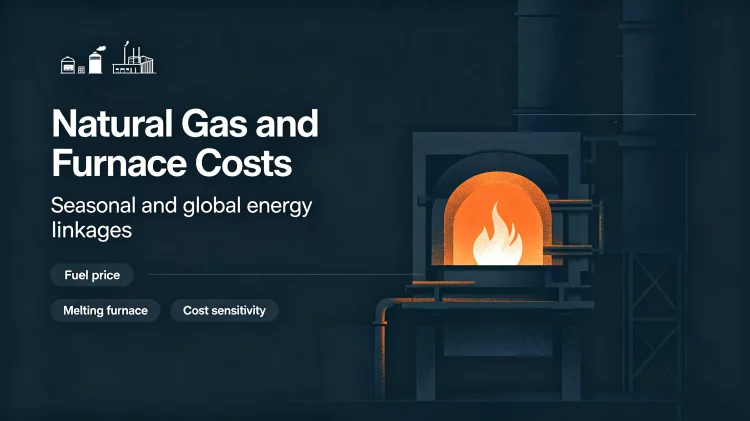
Natural gas is the primary fuel for glass melting furnaces, and its price is influenced by international energy markets, domestic supply policies and seasonal demand. In China, liquefied natural gas (LNG) prices typically rise during the winter heating season and stabilize in summer. However, in recent years, geopolitical factors have increased natural gas price volatility, and the frequency of domestic gate price adjustments has also risen.
According to OilChem data, China’s average LNG market price peaked above RMB 7,000 per tonne in 2023, then fell to between RMB 3,500 and RMB 4,000 per tonne during the summer, reflecting substantial volatility.
Glass bottle production is a continuous process. Once a furnace is ignited, it must operate for a long period, making fuel costs a critical concern. Industry estimates indicate that for every RMB 0.5 per cubic metre increase in natural gas prices, glass bottle production costs rise by approximately RMB 80–120 per tonne. Similarly, every RMB 100 per tonne increase in soda ash prices raises glass bottle costs by roughly RMB 30–50 per tonne.
Industry Response: Efficiency Gains and Higher Cullet Use
When soda ash and natural gas prices rise simultaneously, profit margins for glass bottle manufacturers are visibly compressed, with small and medium-sized enterprises hit hardest. To offset cost pressure, many producers are adopting measures such as staggered procurement, increasing the proportion of recycled glass (cullet) in the batch, optimizing furnace energy efficiency, and reducing bottle weight.
According to a survey by the China Daily-Use Glass Association, the average cullet ratio in the industry has increased from around 20% to more than 30%, with some companies exceeding 50%. Higher cullet use effectively reduces both soda ash and fuel consumption, helping to stabilize production costs.
Outlook and Key Takeaway for Buyers
Looking ahead, soda ash price trends will depend on the pace of new capacity releases and downstream demand matching. Natural gas prices will be shaped by international energy market conditions and domestic supply assurance policies. Glass bottle manufacturers are expected to continue balancing cost control with green transformation, and a greater share of high-value-added products will become a key buffer against future cost volatility.
For buyers and procurement teams, the current cost environment presents a practical window to secure orders at present pricing before further input cost increases are passed through. Locking in supply now can also help avoid peak-season lead time extensions when furnace capacity tightens.
Data Sources
-
SCI99 Soda Ash Market Data: https://www.sci99.com/
-
OilChem LNG Price Data: https://www.oilchem.net/
-
China Daily-Use Glass Association industry survey
-
National Bureau of Statistics of China: https://data.stats.gov.cn/
Note: Price ranges and volatility descriptions are based on publicly available data from 2023 through the first half of 2024. For the most recent monthly data, please refer to the latest reports from SCI99, OilChem, or the National Bureau of Statistics.