The latest figures for 2021 show that the production of glass packaging containers for food and beverages in Europe has grown at an all-time high. Despite facing increasing challenges in the context of the economic crisis, the glass industry remains resilient in the face of exceptionally strong market demand.
Brussels, July 4, 2022: New industry data for 2021 shows strong growth in glass packaging container production in Europe, signaling a continued recovery from the recession in 2020. Glass packaging production for the food and beverage industry increased by 5.0% compared to 2020, reaching an all-time high.
According to the latest data released by FEVE (Federation of European Glass Containers):
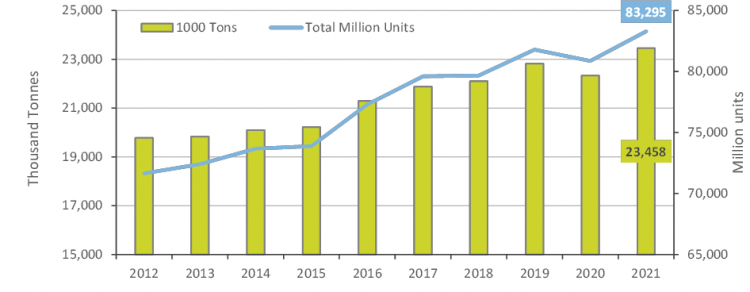
More than 23.4 million tonnes, or 83.3 billion bottles and cans, produced for European and global markets in 2021.
 2021 production figures
Since 2012, the production of glass packaging containers has increased by 18.6%, with an average annual growth rate of 1.7%
 The trend of production data over the years
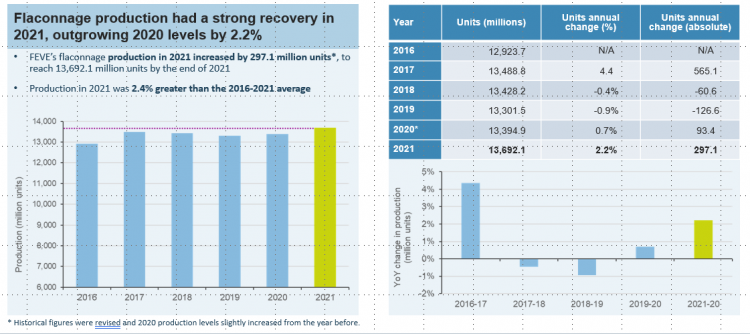
Likewise, the production of perfume bottles, cosmetic bottles and medicinal glass bottles recorded a strong growth of 2.2% by the end of 2021, reaching 13.6 billion units
Perfume bottle, cosmetic bottle and medicine bottle production
 Based on the record production growth, European FEVE Chairman(Vitaliano Torno): “These figures show that, in an effort to meet unprecedented market demand, our glass plants are running at full speed and that we will redouble our efforts to better satisfy consumers. Demand. The glass packaging container industry has risen over the past two years to meet a series of challenges including uncertainty in energy and raw material supply, increasing production costs and market dynamics, and we are proud of this. The beverage industry provides critical packaging materials that ensure the food and beverage industry continues to deliver products to consumers while meeting trends in health, well-being and sustainability. This record growth shows that glass packaging is still It is the first choice of our customers, helping customers improve products, delivering quality and value, and providing products with product packaging that consumers trust.
Product performance and consumer demand—-The way to survive in glass packaging
Glass is a permanent material that can be continuously recycled without loss of quality. 8 out of 10 bottles are recycled every year (see www.closetheglassloop.eu for data) and over 20% of soft drinks, mineral water and beer are filled in reusable glass bottles (2019 global data). No matter how many times you recycle or recycle, glass packaging remains the best guarantee in terms of health and safety, quality, taste preservation and shelf life(Literature report on food packaging materials and their potential impact on human healthby Professor Dieter Schrenk, Professor of Food Chemistry and Toxicology at the Technische Universität Kaiserslautern, Germany, in April 2014 – See -https://www.friendsofglass.com/health/glass-for-your-health/)。
In addition, glass creates the emotional appeal of the product in its unique way, is loved by consumers, and is recognized as a modern material with rich cultural heritage. To this end, the United Nations has designated 2022 as the “International Year of Glass” to thank glass for its contribution to the achievement of the United Nations’ 2030 Sustainable Development Goals.
 Glass packaging has attracted much attention for its long-term contribution to modern society and the global market, Vitaliano Torno concludes: “The International Year of Glass is a unique tribute to a material that underscores the contribution of glass to the market. In challenging times, the glass industry continues to provide stable and sustainable packaging solutions that are trusted by consumers and customers “This recognition also demonstrates the importance of a circular economy model that encourages us to innovate further and leverage cutting-edge technologies to strengthen our sustainability footprint.”