Two Mandatory Chinese Standards Reshape Glass Packaging Compliance Landscape — Effective November 1, 2026
Two industry standards governing glass container quality and surface decoration took effect simultaneously in China on November 1, 2026, raising the baseline for any glass bottle or jar entering the Chinese market — or sourced from Chinese suppliers by international brands.
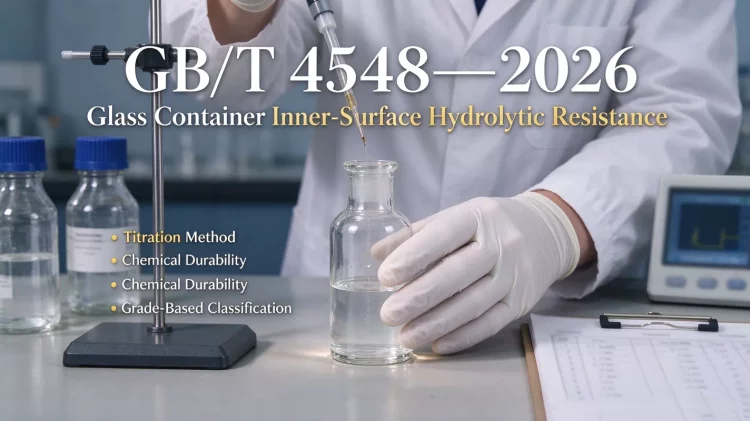
The first, GB/T 4548—2026 (Glassware — Hydrolytic resistance of the interior surfaces of glass containers — Determination by titration method and classification), was issued on April 30, 2026, and replaces the 1995 version of the same method standard. It governs how the chemical durability of a glass container’s inner surface is measured and graded by titration — a property directly linked to content stability, shelf life, and container–content compatibility, particularly for pharmaceutical vials, premium spirits, and sensitive beverage formulations. The standard is administered by the China Light Industry Council and published by the State Administration for Market Regulation alongside the Standardization Administration of China.
The second, JC/T 2145—2026 (Lead-free color glaze for glass), replaces the 2012 edition and converts “lead-free” from a voluntary marketing claim into a technical threshold. It applies to decorative enamels used on cosmetics bottles, baijiu bottles, beer bottles, mineral water bottles, beverage bottles, and pharmaceutical bottles, as well as glassware and tableware. The standard defines lead-free color glaze as a formulation with no intentional addition of lead or its compounds, with lead content below 100 mg/kg in the finished product. It also introduces new performance indicators — lithium content limits for pressure-resistant containers (≤30 mg/kg), a 16 N scratch resistance test, and acid/alkali resistance grading for recyclable bottles — that go materially beyond the previous edition.
Key Compliance Data at a Glance
|
Parameter |
GB/T 4548—2026 |
JC/T 2145—2026 |
|
Scope |
Interior surface hydrolytic resistance of glass containers, by titration |
Lead-free decorative enamel for glass bottles, jars, and tableware |
|
Effective date |
November 1, 2026 |
November 1, 2026 |
|
Supersedes |
1995 version |
JC/T 2145—2012 |
|
Core threshold / method |
Titration-based determination and classification of inner-surface durability |
Lead (Pb) content < 100 mg/kg; no intentional lead addition |
|
Additional limits |
— |
Lithium ≤ 30 mg/kg for pressure-resistant containers; 16 N scratch resistance; acid resistance ≥ Grade 4, alkali resistance ≥ Grade 5 for recyclable bottles |
|
Packaging categories explicitly covered |
All glass containers (general) |
Cosmetics, baijiu, beer, mineral water, beverage, pharmaceutical bottles |
Sources: China State Administration for Market Regulation standard database; JC/T 2145—2026 technical summary
Why This Matters for International Buyers
For brands sourcing glass packaging from Chinese manufacturers, the two standards create a dual compliance surface: the container itself must meet a defined inner-surface durability grade, and any fired-on or printed decoration must sit within a lead-restricted enamel system. The JC/T 2145—2026 thresholds are particularly relevant to premium cosmetics and spirits packaging, where surface decoration is often a core brand asset. A supplier that cannot document sub-100 mg/kg lead content and the new lithium and scratch-resistance indicators now operates below the Chinese industry baseline for bottle-jar decoration.
The standards also matter at the incoming inspection level. Because GB/T 4548—2026 specifies a titration-based classification rather than a single pass/fail line, buyers should expect suppliers to report a hydrolytic resistance grade, not merely a “compliant” declaration. For pharmaceutical and sensitive beverage applications, that grade is a more useful procurement variable than a binary certificate.
About This Report
This release is based on publicly available standard registration data and technical summaries. It is intended for packaging procurement, quality assurance, and regulatory affairs teams evaluating China-linked glass packaging supply.
Comments