Oil Price Shocks and the Cost of Glass Bottles
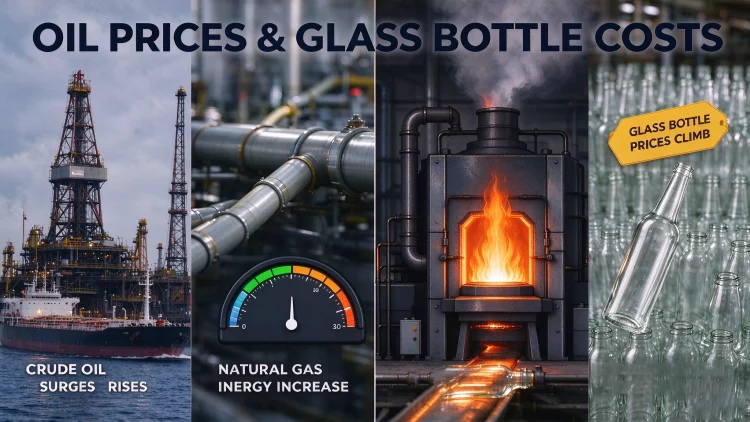
Oil price surges have a direct and significant impact on the cost of glass bottles. This relationship may seem counterintuitive, as glass is not made from petroleum. However, the connection lies in the energy-intensive nature of glass manufacturing. Glass production requires melting raw materials—primarily silica sand, soda ash, and limestone—in furnaces that operate continuously at temperatures between 1,400°C and 1,550°C . This melting process accounts for more than 75% of the total energy consumed in glass container production . When energy prices rise, the cost of running these furnaces rises with them.
Natural gas is the primary fuel used in glass melting furnaces, particularly in Europe and the United States, though heavy fuel oil is also used in some regions . Both are directly linked to crude oil and international energy markets. When geopolitical tensions disrupt oil and gas supply routes, the effect on glass manufacturers is immediate. The 2026 crisis in West Asia, which involved disruptions around the Strait of Hormuz—a chokepoint through which approximately 20% of global petroleum liquids and LNG trade passes—illustrated this dynamic vividly . Brent crude prices surged, and natural gas supplies for industrial use contracted sharply . In India, glass bottle prices rose by approximately 20% as natural gas availability for glass production dropped by a similar margin .
The pass-through mechanism is straightforward. Energy constitutes a substantial portion of glass manufacturing costs. In Germany, energy purchases represent roughly 12% of production value for the hollow glass sector, though this figure can spike during periods of extreme price volatility . For every incremental increase in natural gas prices, the cost of producing a tonne of glass rises proportionally. Industry estimates indicate that for each RMB 0.5 per cubic meter increase in natural gas prices, glass bottle production costs rise by approximately RMB 80–120 per tonne . Because furnaces cannot be shut down without risking catastrophic damage—a complete restart can take six months to a year and cost crores of rupees—manufacturers have little choice but to absorb or pass on these costs .
The effect on glass bottle prices has been measurable and substantial. During 2024–25 and into early 2026, elevated energy costs contributed to glass bottle price increases of approximately 11–17% . In India, glass bottle prices rose 12–15%, with spikes of up to 20% due to gas shortages during the West Asia conflict . Hindusthan National Glass & Industries, one of India‘s largest glass manufacturers, reported that a 35–40% surge in energy costs directly impacted production, forcing the company to cap price hikes at 10–12% while absorbing nearly half of the cost increase . This margin compression is not sustainable over the long term, suggesting that further price increases are likely if energy costs remain elevated.
The vulnerability of glass to energy price shocks also has competitive implications. Glass competes with plastic and aluminum packaging, both of which are also energy-intensive but through different pathways. Plastic depends on petrochemical feedstocks derived from oil and gas, while aluminum production requires enormous amounts of electricity . An oil shock therefore hits all three substrates simultaneously, limiting the ability of brands to simply switch to cheaper alternatives. However, glass has a distinct disadvantage: its weight makes transportation costly, and its production cannot be easily interrupted or ramped down without damaging furnaces. The rigidity of glass manufacturing amplifies the impact of energy price shocks relative to packaging formats that can be produced more flexibly .
Market analysts note that volatility in energy prices, particularly from fast-moving geopolitical events, remains a key upside risk to glass container prices in 2026 and beyond . While soda ash prices have stabilized at lower levels compared to previous peaks, energy remains the dominant variable in glass manufacturing costs . The structural dependence of glass furnaces on natural gas or fuel oil means that any sustained increase in oil and gas prices will inevitably translate into higher glass bottle prices. This relationship is not speculative; it is embedded in the physics of glassmaking and the economics of energy-intensive manufacturing.
32
Comments